
Playwriting in Nigeria: How to Write, Submit, and Get Your Play Produced

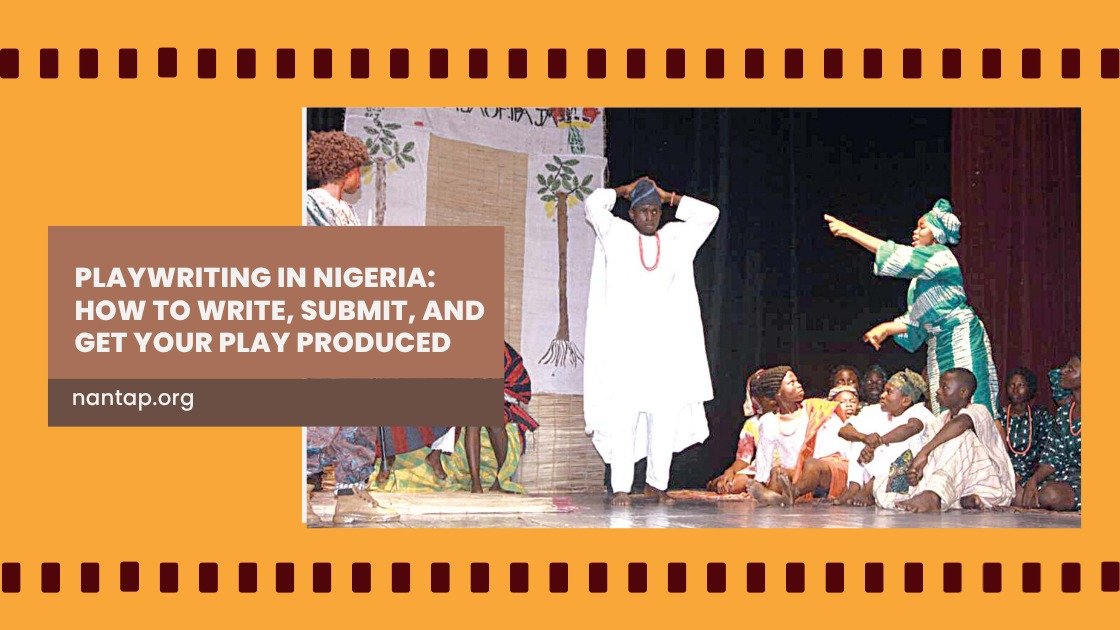
Learning how to write a play in Nigeria means stepping into one of the richest dramatic traditions in the world. From the oral storytelling traditions of the Yoruba, Igbo, and Hausa peoples, to the foundational works of Wole Soyinka, J.P. Clark, and Ola Rotimi – the Nigerian stage has always had something urgent to say.
Yet for every practitioner who has successfully written, submitted, and produced a play, there are dozens who have ideas sitting in notebooks or half-finished scripts on their laptops, unsure of what to do next.
This guide is for them. Whether you are writing your first play or trying to get your fifth produced, this step-by-step breakdown covers the craft, the business, and the specific pathways available to Nigerian playwrights today. In addition, it highlights competitions, festivals, and organisations that actively support new dramatic work.
What Makes a Play Different From Other Writing
Before you write your first stage direction, understand the fundamental nature of a play. A play is not a story to be read. Instead, it is a blueprint for a live event. Every choice you make on the page should therefore serve the people who will perform it, design it, and watch it in a room together.
The key differences between playwriting and prose fiction:
- You cannot enter a character’s internal monologue unless it is externalised through dialogue, action, or direct address to the audience
- Everything the audience knows must come through what they can see and hear on stage
- Dialogue carries the plot, the character development, and the theme — there is no narrator to fill in gaps
- Stage directions should be minimal and purposeful — you are writing for actors and directors, not readers
- Time and space on stage are expensive — scenes need to earn their place
- The theatrical experience is communal — your play must work in a room full of strangers watching together, not an individual reading alone
These constraints are not limitations. In fact, they are what makes playwriting one of the most demanding and most rewarding forms of writing. When it works, nothing compares to the live experience of a great play.
The Three Building Blocks
Every enduring play, from Soyinka’s Death and the King’s Horseman to a debut production at a Lagos black box theatre, is built on the same foundational elements.
Structure
A play needs a shape. The most common structure is the three-act form: a first act that establishes character and situation, a second act that complicates and escalates, and a third act that resolves. However, structure is not a formula, it is an architecture.
Nigerian theatre, for instance, has a rich tradition of non-linear storytelling, ritual drama, and community performance forms that offer alternative structural frameworks. As a result, it helps to understand the conventions before you subvert them.
At its most basic, your play needs:
- An inciting incident — the event that sets the central conflict in motion
- Rising stakes — reasons why the characters cannot simply walk away from the conflict
- A climax — the moment of maximum tension or confrontation
- A resolution — not necessarily a happy ending, but a meaningful completion of the dramatic arc
Character
Characters in a play must be active. Specifically, they must want something desperately, and that desire must drive the plot forward. Furthermore, the conflict of a play is almost always the collision between what different characters want.
Strong theatrical characters share several qualities:
- They have a specific, concrete objective in each scene
- They have a backstory that explains why they want what they want, even if none of it is stated directly
- They speak in a distinctive voice because each character should sound different from the others
- They change, resist change, or are destroyed by their inability to change — that arc is the dramatic engine
Dialogue
Dialogue in a play is not conversation, it is action. In other words, every line a character speaks is an attempt to get something, deflect something, reveal something, or conceal something. As a result, when characters are simply exchanging information or explaining the plot, the play grinds to a halt.
Read your dialogue aloud constantly. If it sounds unnatural, rewrite it. Nigerian theatrical dialogue, whether in English, Pidgin, Yoruba, Igbo, or a multilingual blend, has enormous expressive range. Moreover, the best Nigerian playwrights use language as a political and cultural instrument, not just a communication tool.
Practical exercise: Take any scene from your script and identify what each character wants in that scene. If you cannot answer that question clearly, the scene needs rethinking.
Writing the Nigerian Play: Context, Voice, and Originality
Nigerian theatre has a specific identity, and the most powerful Nigerian plays draw on that specificity rather than apologising for it or flattening it for international audiences.
Finding Your Territory
Some of the most productive creative territories for Nigerian playwrights right now include:
- Urban experience — Lagos, Abuja, Port Harcourt, Kano as landscapes of aspiration, contradiction, and survival
- Historical reckoning — colonial memory, civil war trauma, pre-colonial traditions, and their resonance in contemporary Nigeria
- Gender and power — the evolving roles of women, the performance of masculinity, and the silences around sexuality
- Religion and spirituality — the intersection of traditional belief systems, Christianity, and Islam in everyday Nigerian life
- Technology and identity — how smartphones, social media, and digital culture are reshaping Nigerian social life
- Migration and diaspora — the experience of Nigerians abroad and the complex relationship with home
- Political life — governance, corruption, civic engagement, and resistance
Write about what you know. More importantly, write about what keeps you awake. After all, the most universal plays are almost always the most specific ones. A play deeply rooted in the particular details of Ibadan or Onitsha or Maiduguri will resonate globally precisely because of that specificity, not despite it.
How to Format Your Play Script Professionally
A professional script format signals to directors, producers, and judges that you are serious. In addition, submitting a play in an unprofessional format creates a poor first impression before a single line of dialogue is read.
Standard play script formatting guidelines:
- Use a standard font — Courier 12pt is traditional; Arial or Times New Roman 12pt are also acceptable
- Character names are centred or written in ALL CAPS before their lines
- Stage directions are indented, italicised, and typically written in the present tense
- Each new scene should be clearly headed with location and time
- Page numbers should appear on every page
- The title page should include the play’s title, your name, contact details, and the draft date
- Include a dramatis personae (character list) with brief descriptions at the front of the script
Several free and affordable playwriting software tools make formatting automatic — Final Draft, Fade In, Celtx (which has a free tier), and WriterDuet are all widely used. Many Nigerian practitioners use Microsoft Word with a customized template. Regardless of the tool you choose, what matters most is consistency and clarity.
Where to Submit Your Play
Finishing your script is the beginning, not the end. Fortunately, the Nigerian theatre ecosystem has a growing number of platforms, competitions, and organisations that actively seek new dramatic work.
Local and National Submission Platforms
The Akete Theatre Competition (NANTAP / Lagos State Government)
The Akete Theatre Competition, organised by NANTAP’s Lagos Chapter in partnership with the Lagos State Government, is one of Nigeria’s most prestigious playwriting platforms.
Launched to document Lagos history and develop a new body of dramatic literature, the competition accepts original, unpublished plays.
Lagos State publishes the winning play and incorporates it into the school literature curriculum, giving the playwright both recognition and legacy. NANTAP structures the competition as an annual event, making it a regular submission target for Nigerian playwrights.
The Akete Theatre Festival
Beyond the competition, the Akete Theatre Festival provides a production platform. The festival stages selected plays over multiple days, giving playwrights the experience of seeing their work performed before live audiences — an invaluable step in developing any script.
NANTAP State Chapter Productions
NANTAP’s 27 state chapters regularly produce plays and actively seek new work by Nigerian playwrights. As a result, connecting with your state chapter is one of the most direct routes to production.
State chapter productions also offer the opportunity to workshop your play, seeing how it holds up in rehearsal and making adjustments before a final production.
University Theatre Departments
Theatre arts departments at UNILAG, UI, OAU, UNIBEN, and other universities regularly produce plays as part of their academic programmes.
For emerging playwrights in particular, submitting to university theatre departments especially for productions that explore Nigerian themes relevant to their curriculum is a highly viable route.
International Submission Opportunities
Nigerian playwrights increasingly submit to international platforms. For example, the Royal Court Theatre in London has a long history of developing African playwrights through its International Residency programme.
Similarly, the Eugene O’Neill Theater Center in the United States accepts international submissions. Various African theatre festivals, including the MASA festival in Abidjan, also provide platforms for Nigerian dramatic work.
Furthermore, NANTAP’s affiliations with the International Theatre Institute open doors to international submission networks that members can access directly.
Independent Theatre Companies
A growing number of independent theatre companies in Lagos, Abuja, and Port Harcourt actively develop new Nigerian plays. Research companies whose aesthetic and thematic interests align with your work, then approach them with a professional submission package including a synopsis, the full script, and a brief writer’s biography.
How to Get Your Play Produced: The Producer Relationship
Writing the play is one skill set. Getting it produced, however, requires a different one — the ability to communicate your vision persuasively, negotiate agreements professionally, and collaborate with directors, designers, and performers who will interpret your work.
When approaching producers:
- Have a compelling one-page synopsis that conveys the story, the themes, the characters, and why this play needs to be staged now
- Know your ideal cast size and production requirements — producers need to assess production costs
- Be clear about your rights position — what licence you are offering, what royalty arrangement you expect, and what approval rights you retain over casting, design, and adaptation
- Be coachable — the best playwright-producer relationships are collaborative, not adversarial
- Protect your work — register your script with the NCC and ensure any production agreement is in writing before rehearsals begin
Ultimately, the relationship between playwright and producer is one of the most important professional relationships in theatre. Invest in it carefully.
Developing Your Craft: Workshops, Mentors, and Community
Playwriting is a discipline. It improves with practice, feedback, and exposure to work that challenges you. Building your craft therefore means:
- Writing consistently — a new scene every week, a new play every year, even if incomplete
- Attending productions and studying what works and why
- Reading widely in the playwriting canon — Nigerian, African, and international
- Seeking feedback from directors and dramaturgs who can read your script with a production eye
- Participating in playwriting workshops — NANTAP’s national convention and state chapter events regularly include scriptwriting workshops facilitated by veteran practitioners
- Connecting with a community of writers for honest, rigorous peer review
NANTAP designs its national conventions and workshops specifically to build practitioner skills at the highest level. The 2024 National Delegates Convention, for instance, featured workshops on scriptwriting, directing, and digital theatre innovations — exactly the kind of targeted development serious practitioners need to stay competitive.
Final Thoughts: The Nigerian Stage Is Waiting
Nigeria needs new plays. Not just any plays, plays that speak to the complexity of contemporary Nigerian life with honesty, craft, and creative ambition. The country’s theatrical tradition is one of the great strengths of its cultural identity, and every generation of playwrights has a responsibility to add to it.
The pathway from idea to produced play is not mysterious. It requires craft, persistence, professional support, and connection to the institutions like NANTAP that are actively building the infrastructure for Nigerian theatre to flourish.
The Nigerian stage is not waiting for a perfect play. It is waiting for your play written with honesty, built with craft, and submitted with the professional confidence of a practitioner who knows their rights and knows their worth.