World Theatre Day in Nigeria: History, Celebrations, and What It Means for African Storytelling

Every year on the 27th of March, stages across the world light up for a single shared reason. It has nothing to do with any one production or performer. It is World Theatre Day, a global celebration of one of humanity’s oldest and most powerful art forms. And in Nigeria, it is a day that carries particular weight.
For Nigerian theatre practitioners, World Theatre Day is not simply a date on an international calendar. Rather, it is an annual moment of reckoning, celebration, and advocacy.
It is the day the National Association of Nigerian Theatre Arts Practitioners (NANTAP) and its state chapters gather to remind the country of what theatre is, what it does, and why it deserves to be taken seriously as both a cultural institution and an economic force.
This piece covers the origins of World Theatre Day, how Nigeria has made it its own, what NANTAP’s role has been in embedding it into the national cultural calendar, and what it means for the future of African storytelling on the global stage.
Where It All Began: The Origins of World Theatre Day
World Theatre Day was born out of a post-war conviction that culture could heal what conflict had broken. In June 1961, the ninth World Congress of the International Theatre Institute (ITI) convened in Vienna. There, Finland’s ITI Centre President Arvi Kivimaa proposed a dedicated global day to celebrate theatre’s role in building peace and understanding across nations.
The idea found broad support, particularly among the Scandinavian ITI centres. As a result, the first official World Theatre Day was celebrated on the 27th of March 1962. The date coincided with the opening of the prestigious Theatre of Nations season in Paris. Jean Cocteau, the French poet and filmmaker, wrote the inaugural International Message setting a tradition that continues to this day.
Since 1962, the ITI has commissioned an annual message from a figure of global stature in theatre. The ITI translates this message into multiple languages and circulates it to centres in over 90 countries. It forms the philosophical heartbeat of the day’s celebrations worldwide.
World Theatre Day has been observed every year on March 27 without interruption since 1962, making it one of the longest-running international cultural observances in history.
Nigeria and World Theatre Day: NANTAP Leads the Way
Nigeria’s engagement with World Theatre Day is inseparable from the work of NANTAP. As the body responsible for professionalising theatre arts practice in Nigeria, and as the country’s affiliate of the ITI, NANTAP took up the task of making World Theatre Day a meaningful national event.
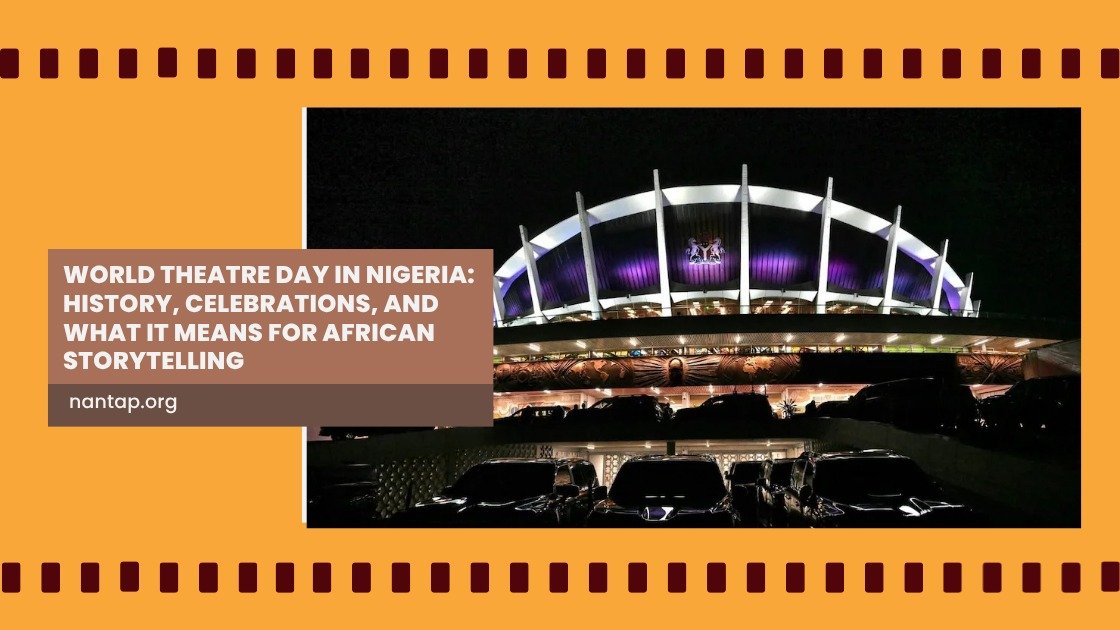
The association has been celebrating World Theatre Day across its state chapters for over a decade. The Lagos Chapter has consistently led the way. One of the most significant celebrations took place at the Queen Amina Square of the National Theatre in Lagos.
Theatre practitioners, National Theatre management staff, and students from higher institutions gathered there to mark the occasion. The theme was Theatre, A Beacon of Hope and National Rebirth.
That event also served as a thanksgiving celebration for the Lagos State chapter. In doing so, it blended the global significance of the day with the local story of practitioners who had persisted, organised, and built something meaningful against considerable odds.
The National President of NANTAP, Adeniran Makinde, confirmed that multiple state chapters were observing World Theatre Day celebrations. He also announced plans to expand the event’s reach across more of the association’s 27 chapters in subsequent years.
What Happens on World Theatre Day in Nigeria
World Theatre Day celebrations in Nigeria are layered. They combine the ceremonial with the practical, and the artistic with the political. Across NANTAP chapters, activities typically include:
- Live theatre performances by professional practitioners and student groups
- Advocacy lectures connecting theatre to pressing national conversations on governance and social development
- Book presentations and academic seminars on Nigerian theatre history and technique
- Award ceremonies recognising cultural ambassadors and distinguished personalities in the arts
- Street theatre, processions, and community performances that take the art form to public spaces
- Press briefings where NANTAP leadership communicates the association’s position on creative industry policy
- Panel discussions on the state of Nigerian theatre, funding gaps, and the path forward
Theatre as Public Advocacy
Beyond the performances, World Theatre Day in Nigeria has consistently served as a vehicle for civic action. In 2011, for example, the Lagos Chapter organised a Great Walk from Maryland to the National Theatre in Iganmu.
The walk advocated for credible elections and good governance. It drew participants from across Lagos in a powerful public demonstration of theatre’s social function.
That single event captured what World Theatre Day in Nigeria is at its best: a performance, a protest, and a statement of purpose all at once.
The International Message: Nigeria’s Connection to a Global Conversation
Each year, the ITI invites a theatre personality of international standing to write the World Theatre Day International Message. Practitioners read this message at events worldwide. They also share it across media platforms in dozens of languages.
Past authors include figures from Europe, Asia, Latin America, and Africa. Each brings their own cultural lens to the universal theme of Theatre and a Culture of Peace.
For Nigerian practitioners, engaging with this message is an act of connection. It is a reminder that their work belongs to a global tradition stretching back over six decades and touching every continent.
NANTAP has consistently used the publication of the annual message to reach members across all 27 state chapters. The association facilitates readings and discussions that connect local practitioners directly to the international conversation.
What World Theatre Day Means for African Storytelling
The significance of World Theatre Day for Nigeria extends beyond celebration. It is a platform. And Nigeria’s theatre community has used it as one.
African theatre has long been underrepresented in the international cultural conversation. This is despite the continent’s extraordinary depth of performance tradition.
From the masquerade theatre of the Yoruba to the ritual drama traditions across the Niger Delta, the heritage runs deep. From the politically charged works of Wole Soyinka to the contemporary productions reshaping Lagos stages today, African storytelling through performance is a living, evolving, global contribution.
Placing Africa at the Centre of World Theatre
World Theatre Day provides an annual moment to assert that contribution publicly. When NANTAP gathers practitioners at the National Theatre, issues advocacy statements, and connects to the ITI’s international network, it takes a politically significant action.
It places Nigerian and African theatre in its rightful context — as part of world culture, not a footnote to it.
Moreover, the day actively serves the next generation. When theatre students from Nigerian universities attend World Theatre Day events alongside working professionals, they gain something invaluable.
They encounter the full scope of what a theatre career can mean: local craft, national advocacy, and international belonging.
How to Participate in World Theatre Day in Nigeria
World Theatre Day welcomes everyone — not only professional practitioners. There are meaningful ways for anyone to engage:
- Attend World Theatre Day events organised by your NANTAP state chapter on or around March 27
- Visit a theatre production during the celebration period; many events offer discounted or free admission
- Read the annual World Theatre Day International Message and share it on your social media platforms
- Follow NANTAP’s national and state chapter pages for event announcements and updates
- If you are a student or emerging practitioner, use the day to connect with the professional community
- If you are not yet a NANTAP member, use World Theatre Day as the moment to formally register and join Nigeria’s theatre community
Final Thoughts
World Theatre Day in Nigeria is more than a calendar event. It is a statement. Every year on the 27th of March, NANTAP and its chapters deliver the same message: theatre is alive, professional, and economically significant. It deserves the investment and respect that every other serious industry receives.
For those inside the Nigerian theatre community, the day is a moment of pride and renewed commitment. For those outside it, on the other hand, it is an open invitation. Come to a performance. Support a practitioner. Read a play. Or simply recognise that the stage is one of the places where Nigeria tells the truth about itself most clearly.
Mark March 27 in your calendar. Follow NANTAP. Show up. The curtain rises whether you are there or not — but it is always better with a full house.